Logo
BSF Enterprise PLC

A BSF Enterprise company Cell-grown leather for luxury fashion and automotive

Lab-Grown Leather

Lab-Grown Leather grows collagen-based leather from cells for luxury fashion and automotive interiors. The material is tanned and finished like conventional leather, and is built on the Group’s core technology, developed and owned by 3D Bio-Tissues.

Lab-Grown Leather within the BSF Enterprise group: 3D Bio-Tissues at the centre supplies technology to Lab-Grown Leather, Kerato and milieu.bio, which sells the CytoBoost™ and CityMix® media supplements, and licenses ETSYL® for skincare 3D Bio-Tissues IP & manufacturing Kerato Corneal repair ETSYL® Skincare licensing Lab-Grown Leather Luxury & automotive materials milieu.bio CytoBoost™ & CityMix®
As seen in Vogue

T-Rex Leather™ in fine jewellery

CFDA/Vogue Fashion Fund 2026 · Material Innovation Challenge

Lab-Grown Leather Ltd, part of the BSF Enterprise Group, was one of 14 material innovators in the 2026 CFDA/Vogue Fashion Fund Material Innovation Challenge. Finalist George Inaki of MILAMORE made the Kintsugi Heart, a T-Rex Leather™ cuff with a broken-heart clasp in 18k gold, silver and natural diamonds, featured by Vogue.

T-Rex Leather™ is grown from a collagen sequence reconstructed from fossil protein evidence: one application of the Group’s tissue-engineering platform.

T-Rex Leather™ and IMPOSTER, designed by George Inaki for MILAMORE. T-Rex Leather™ made by Lab-Grown Leather Ltd (ATEP™ platform), with The Organoid Company and VML.

How the leather is made

Lab-Grown Leather grows leather from cells. Using 3D Bio-Tissues’ technology, the cells produce collagen and build the tissue themselves. The result is a collagen-based material that is tanned and finished like conventional hide.

The technology behind it: 3D Bio-Tissues
  1. Cells make the material

    The leather is made of cells and the collagen-rich tissue they produce, rather than plastics or plant fibres.

  2. Cells build their own structure

    The cells organise themselves and form the tissue’s structure, growing only the layer used to make leather.

  3. Tanned like conventional leather

    The grown tissue goes through standard tanning and finishing. In March 2026 Lab-Grown Leather produced its first tannable A4-sized skin.

Why grow leather?

Growing leather from cells changes what goes into the material and how it is made.

  • No animals farmed for hides

    The leather is grown from cells, so no animals are raised or slaughtered to produce it.

  • Made of collagen, not plastic

    Unlike many leather alternatives, the material is collagen-based rather than made from polyurethane or other plastics.

  • Grown without hide flaws

    Grown under controlled conditions, the material has none of the scars, bites and brand marks found on animal hides, so less needs to be cut around.

  • Fewer processing steps

    Only the layer used for leather is grown, with no hair, fat or outer skin. That removes the early stages tanneries use to strip these from hides.

The material up close

A short film of Lab-Grown Leather’s cell-grown material in the lab, made with 3D Bio-Tissues’ technology.
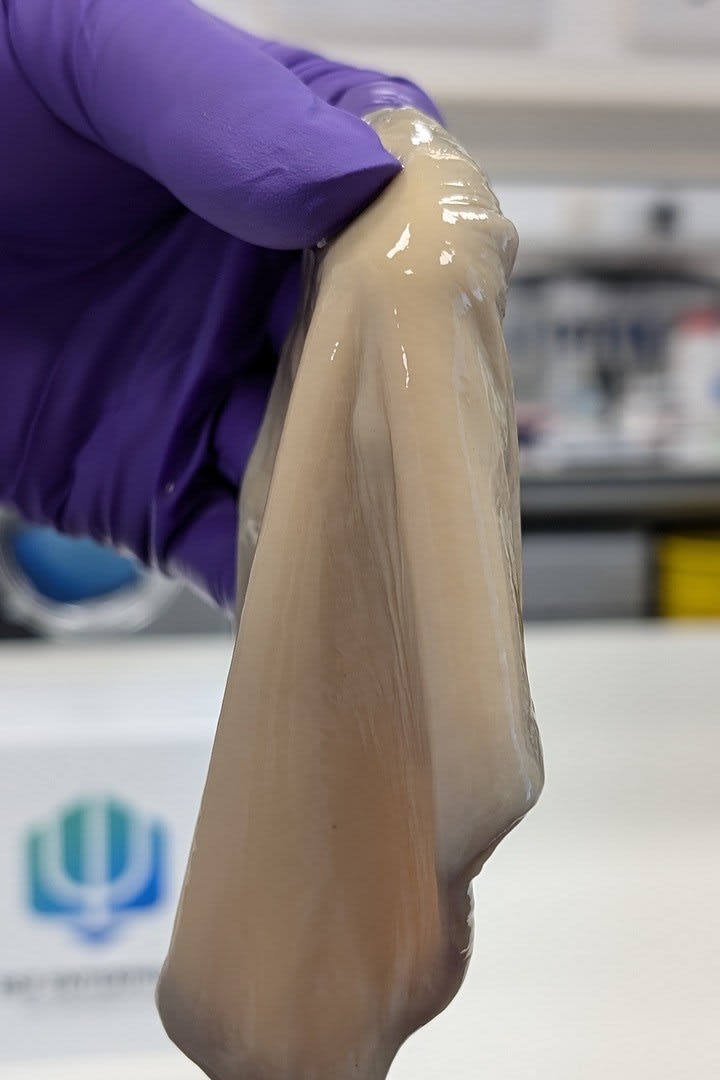
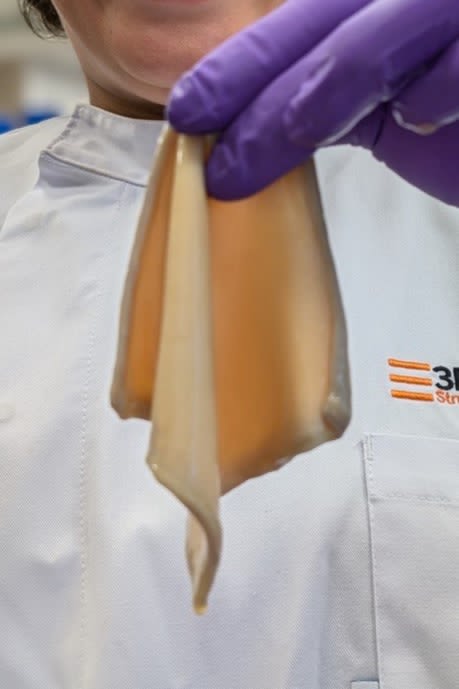
Film: Lab-Grown Leather in the lab. 29 seconds, January 2025.

Luxury fashion and automotive

Lab-Grown Leather is focused on two markets where provenance and material quality matter most. Both have work under way with partners.

Luxury fashion

  • Paid material evaluation programmes with two global luxury fashion houses, using Elemental Lux™.
  • The first product made from T-Rex Leather™, a handbag, unveiled in April 2026.
  • One of 14 material innovators in the 2026 CFDA/Vogue Fashion Fund Material Innovation Challenge.

Luxury automotive

  • A memorandum of understanding with SCHAKAU to bring Lab-Grown Leather materials to bespoke, ultra-luxury programmes with European automotive manufacturers, through SCHAKAU’s industry network.

Featured News